
Is The Odyssey historically accurate?
Has this annoying thing happened to you? Having seen a film, your friend says, ‘Yeah, it was okay, but that scene when they got off the train? The film was set in 1981 but that class of loco went out of service in 1973.’ Or your gardening friend who says, ‘It was supposed to be the middle of summer, but in the background you could see clematis, which blooms in the spring.’
You would be thinking, ‘Who cares?’ But when it comes to something where I have particular knowledge, I find myself getting irritated with the lack of research. Anyone interested in textiles will know of examples of sloppiness or even instances of deliberately not caring.
The hilarious television programme, Upstart Crow, is a comedy about William Shakespeare’s life. In his London digs, there are small tapestries on the walls, looking a bit like the Lady and the Unicorn series. Of course ordinary people would not have owned tapestries, and tapestries of the time were on a huge scale.
Those who know about fashion history can name numerous instances of mistakes in historical novels. Seventeenth-century women may be said to be wearing drawers or even bloomers, at a time when ‘bifurcated’ garments were thought to be masculine and therefore inappropriate.
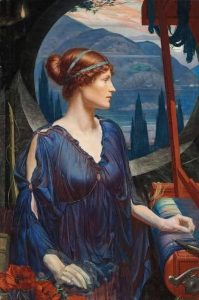
Pre-Raphaelite painting depicting Penelope at her loom, a version not invented until the modern era.
In the excellent novel set in ancient Greece, The Silence of the Girls, by Pat Barker, enslaved women are described as working at weaving. There are several references to the clattering of the looms, but the type of loom used at the time did not make noise.
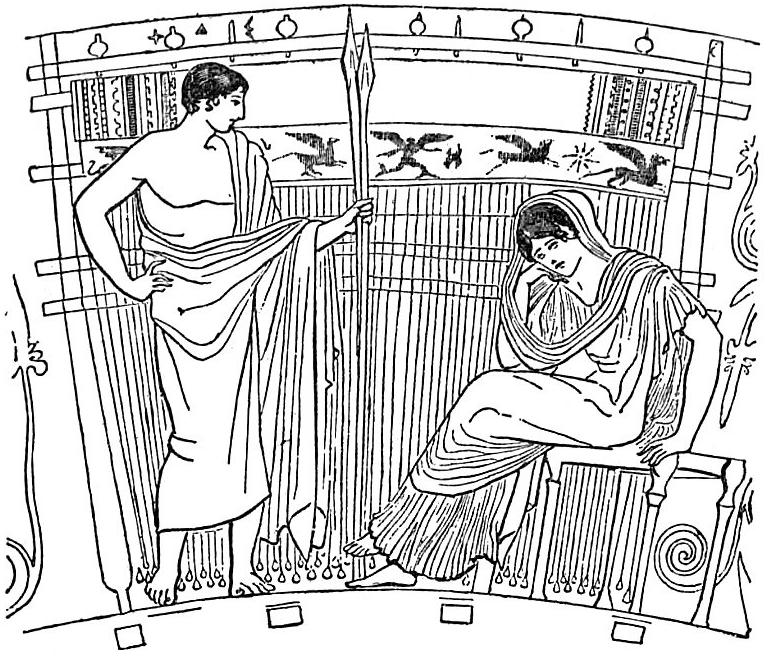
Currently, the film The Odyssey shows Penelope at the loom, where she is famously putting off the numerous suitors by saying she must finish the shroud for her father-in-law before she can consider remarriage. Looms of the era were made with two uprights and a top beam. Weaving would start at the top of the loom and progress downwards. The warp threads would be tied to heavy weighs to maintain the tension. In the film, you never see the bottom of the loom, so it is impossible to know whether it is accurate. However, I am going to be picky and say that the tension on the loom looked too strong and the warps never moved when Penelope was weaving. So I am going to condemn The Odyssey for this one error.
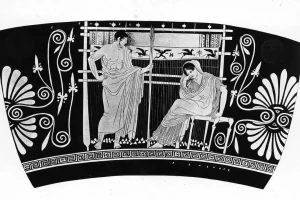
From an 430 BCE Greek vase, showing Penelope and her son Telemachus, in front of her loom. Each warp thread has a loom weight attached to it.